

Rabbi Rebecca writes:
This week is Tzaria-Metzora, the double portion of the Leviticus describing infectious disease. It couldn’t resonate more strongly.
I love the way we are all trying to make sense or learn from what is happening. Why wouldn’t we search the past and literature for echoes?
In 1947, having just emerged from fighting in the World War II French underground, Albert Camus completed and published his novel, The Plague (La Peste).
The story creates and imagines a contemporary-day outbreak of the Bubonic Plague in a small and rather ordinary Algerian town, Oran. The hero, Dr Rieux, looks after the victims every day, until the disease passes, after many, many have died.
So Dr Rieux’s tale, the book concludes, “could not be one of final victory. It could be only the record of what had to be done and what assuredly would have to be done again in the never-ending fight against terror… by all who, while unable to be saints but refusing to bow down to pestilences, strive their utmost to be healers.” (My italics)
The message of the book is bleak but uplifting; the plague never dies, really, and with people, “There are more things to admire than to despise.”
How can this not sound familiar? Especially when Camus describes a city overrun, hospitals running out of beds and health care workers lacking basic equipment, and larger spaces required for the dying and then dead.
I studied La Peste in French class at school when I was 16. I was moved then and I am moved now. But more so by the backdrop of rereading this. And that it’s true with people, “There are more things to admire than to despise.” And it’s true that many of us, not just our doctors, nurses and carers, by refusing to to bow down to pestilences strive their utmost to be healers.
There is nothing romantic about what we are going through now. At the beginning we thought ‘we were in this together’ but time has confirmed that is not so. There is a palpable difference between those on lower incomes bearing the virus. Quarantine in a garden with rooms for all the family is a far cry from what many are experiencing. But all is relative.
For many, it has brought out unusual resilience and kindness, and a desire to reach out. Camus’s observation of life in quarantine resonates but so does his observation when the plague ends that all people crave ‘human love’. I’m determined to capture that craving for ‘human love’ and make it a palpable through acts of kindness and public calls for justice.
That is what I am thinking on now.
Rabbi Rebecca
Here are a couple of thoughts for the week, from Zoe Jacobs and Megan Greene.
Message from Rabbi Rebecca
I am loving what everyone is sharing online and in their Postcode Groups at the moment. As well as shopping, these uplifting snippets of books and stories nourish us in these times.
Member Marilyn Branston shared this from Leo Rosten’s book “Captain Newman, M.D”. She writes [it’s a ] really wonderful novel about a psychiatrist treating soldiers returned from combat in WW2. I believe a film was made of this novel many years ago, and if ever you wanted to obtain a copy (used, probably) you’d be well rewarded”.
At the very end of the novel, Captain Newman and a couple of his friends are taking a well-earned rest on a sandy beach, and musing about the tragedy of the war and the human cost of it all.
Newman tells the following story:
“My father once told me a story I always think of when the going gets rough…It’s about Destiny. Destiny came down to an island, centuries ago, and summoned three of the inhabitants before him. ‘What would you do,’ asked Destiny, ‘if I told you that tomorrow this island will be completely inundated by an immense tidal wave?’ The first man, who was a cynic, said, ‘Why, I would eat, drink, carouse and make love all night long!’ The second man, who was a mystic, said, ‘I would go to the sacred grove with my loved ones and make sacrifices to the gods and pray without ceasing.’ And the third man, who loved reason, thought for awhile, confused and troubled, and said, .Why, I would assemble our wisest men, and begin at once to study how to live under water.’”
Adapting seems to be critical at the moment. Managing these new conditions with ease and even flexibility. I think many are sacrificing so much – our children and young people are giving up long held hopes and promises. UJIA has officially cancelled Israel Tour this year, I know it feels small fry for some of us but many of our 16-year-olds raised through their youth movements know that their rite of passage visiting Israel after GCSEs was as certain as the exams themselves.
It is no small thing to lose all of that and to do so graciously and without hysteria or even self pity. Not one to feel the plight of our advantaged young people, I do so here for this. I commend our Youth movement LJY-Netzer and its members for managing the disappointment so well. It bodes well for their future.
We have focused on the Serenity Prayer in this week’s Morning Meditation; the ability accept what you can’t change, the courage to change what you can and the wisdom to know the difference.
I’m telling the young people I speak to and see ‘Gam Zeh Y’avor’ this too will pass and good will be ahead.
Shabbat Shalom
Message from Rabbi Rebecca
At some point in the 1650s, the French philosopher and mathematician Blaise Pascal jotted down one of the most counter-intuitive aphorisms of all time:
‘The sole cause of man’s unhappiness is that he cannot stay quietly in his room.’
Oh my goodness how this resonates this week.
I don’t usually find myself agreeing with Piers Morgan but his plea this week made me smile, it was along the lines; Britain you haven’t been asked to go fight in the trenches, you’ve been asked to go home and watch telly…
Why is this so hard for us?
It is strange.Those who have had an ambivalent relationship to technology are now wholly dependent on it. Those of us who rely on the charismatic visceral nature of face to face encounters are now having to create something different and create it pretty swiftly.
Dora is just coming out of Corona Virus symptoms we think, so we are all self isolating. I am leading a Shiva tonight via Zoom. A new but not unpleasant experience. Services this Shabbat will be virtual for us all. I am constantly, with Zoe, thinking of ways to bring us together even through Pesach, to separate Shabbat from other days, and to clear out chametz, all whilst we are alone in our kitchens and living rooms.
For those who wake with anxiety and fears, perhaps try to look ahead just next week rather than beyond and into the future. I think in my own spiritual practice and indeed life’s work there is something for me about surrendering control, and goodness is this one great lesson in that!
Be in touch if you need me. I am on phone and email constantly.
Shabbat Shalom
Rebecca

We have reached our first Shabbat together in this new world we temporarily inhabit.
Here at FPS Pauline, Zoe and I are still here and have been busy building structures to allow us to stay connected. Call and you will get one of us on the phone, we are doing everything we can to ensure we are are still operational, even if asked to stay at home.
I want to share a little of my week, it has been very focused on supporting couples cancelling weddings, B’nei Mitzvah being postponed and our members adjusting to this as well as our school students.
I feel so keenly for our 16 and 18 year olds and missing out on their exams and moving through GCSE and A Levels and leaving school at the right moment. I wonder if we understand well being cheated out of a rite of passage when it’s so needed. Judaism captures these moments for us.
It has been said everyone can;
At five years of age the study of Torah;
At ten the study of Mishnah;
At thirteen child of the commandments;
At fifteen the study of Talmud;
At eighteen the chuppah;
At twenty earn a living;
At thirty the peak of strength;
At forty wisdom;
At fifty able to give advice and so forth. (Pirkei Avot 5)
There is a time for everything, as Ecclesiastes reminds us and right now we have to be creative when that can’t happen as expected.
Yesterday morning at 4am a beloved member Viviennne Lakra died, despite ‘social distancing’ I was able to be with the family yesterday and this morning and to plan for the funeral this Sunday, the first for our community under the new Covid-19 measures. Only 20 people at the graveside, with the Ohel (prayer hall) closed and a Shiva for the family that must accept remote messages and visits rather than real ones. We will manage this along with everything else.
The human spirit is resourceful and resilient.
Shabbat Shalom to you all and do join us for our online services today.
Rabbi Rebecca
Purim for FPS fell on International Women’s Day; we photographed all women and girls on the Bimah. Despite the hiatus in Liberal Judaism when Purim fell distinctly out of favour, we had a full house. Fairy tales and silliness are back in fashion. Thank you so much to Nina Hirsch for her brilliant Spiel for the children of Ivriah and their fabulous voices; and to Sheila and Josie for such entertaining reading of Megillah Esther. As well as the mocktail makers and feast providers.
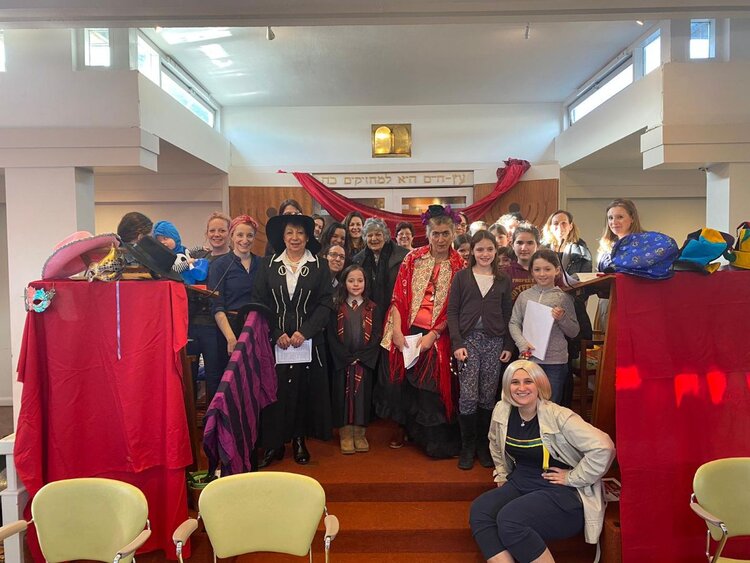
Looking ahead to this Shabbat it’s Parashat Ki Tissa the debacle of the Golden Calf. Make us a god/gods to worship (32:1) ; Asher Kinchin -Smith 4th generation FPSnik will chant these words for us and remind us every generation gets impatient and can be guilty of making gods in our own image. This portion is a lesson in Moses’ patience, God’s intolerance and the realism of doubt. It’s an important part of Torah this week’s portion; Moses breaking the first set of tablets in a moment of rage as he sets eyes on the Golden Calf, and the broken tablets living in the Ark, in the mishkan alongside the second perfect set.
As Jews we’ve never been afraid of doubt or questions. Religion for adults means embracing complexity. So wrote Sarah Hurwitz, former Speech writer for both Michelle and Barak Obama, in London next week to promote her excellent book Here All Along: Finding Meaning, Spirituality, and a Deeper Connection to Life–in Judaism (After Finally Choosing to Look There).
I’m going to hear her speak at JW3, do come with if you fancy.
Wishing you a Shabbat Shalom
Rebecca
‘It was seeing people wearing shorts and sneakers that drew me to FPS’. I cannot tell you how many times I have heard this. In describing the informality (in a good way) of our synagogue, dress is always mentioned. How often visitors might ask ‘What should I wear to your synagogue?’ Clothes matter. Many still wear suits, ties and the equivalent. But many celebrate being able to wear jeans and to ‘come as you are!’
Do Liberal synagogues mark themselves by having a more ‘relaxed’ dress code? I have certainly seen that at play.
Similarly our attitude to ‘sacred garments’; who wears a tallit or a kippah? Last year someone commented to me that he was surprised to see women wearing trousers with a tallit. I was, I must admit, a bit at a loss for words, I wasn’t sure how to respond to this particular concern. I know how many comments I receive if I am wearing a new dress or an unusual colour (or indeed any colour!). We do look at our prayer leaders, so maybe what they wear does matter. A colleague (male) was asked to dress a little smarter. Another colleague prefers no shoes, not a common look in synagogue prayer.
As with most things, Judaism does speak to attire. This week’s portion holds the sartorial instructions for the priests:
“These are the vestments that they shall make: a breastpiece, an ephod, a robe, a fringed tunic, a headdress, and a sash. They shall make those sacral vestments for your brother Aaron and his sons, for priestly service to Me; they, therefore shall receive the gold, the blue, purple, and crimson yarns and the fine linen.” (Ex. 28:4-5)
Without the formality of Temple sacrifice and priestly leadership, what is the correct garb for us rabbis and lay folk? Is it possible our elaborate Torah mantles and rimonim (silver crowns) have replaced the priestly garments? And does that affect how we behave with our sifrei Torah (Torah scrolls).
This week we will study Tetzaveh and, I hope, have these conversations at Cafe Ivriah starting at 9.45 am. Do join us and wear whatever you like!
Wishing you a Shabbat Shalom
Rebecca
Humanity has been well used to expressing suspicion and even hatred for those other than us.
We naturally cleave to and feel comfortable with those who feel like us. The eugenics conversation entering Downing Street this week echoes such ideas.
Humanity’s greatest crimes have been committed against the outsider, the stranger. We have seen the casualties of this for centuries. So it is all the more arresting to read:
“You shall not oppress a stranger, for you know the heart of a stranger: You were strangers in the land of Egypt” (Ex. 23:9).
It cuts through all the other verses in this week’s portion as it should; a clear-eyed focus on what matters. 36 times this verses is repeated in various forms in the Torah. It seems to remind there is always a choice how to think, believe, speak and behave. I appreciate its simplicity even when other messages and texts around it are not.
Empathy was and is a Jewish commandment.
Wishing you Shabbat Shalom
Rebecca
Self-care is never a selfish act – it is simply good stewardship of the only gift I have, the gift I was put on earth to offer others. So wrote Parker Palmer.
The constant search for a good life; one where we give as much as we receive is a reasonable goal and where we live easily and thoughtfully. Where life is both bearable and even joyful.
This week’s portion is Yitro. Moses’ father-in-law (clearly a highly functioning and astute priest of Midian) told him, “What you are doing is not good.” He was referring to the state of exhaustion Moses was in daily; the burden and centrality he gave himself to serve the people. Basically Yitro told Moses to delegate.
We serve no-one well when we we wear ourselves out. It’s rather nice to be reminded that self care is good stewardship. Consider what changes you could make in your lives to enable this.
Wishing you a peaceful and restorative Shabbat.
Rebecca
Copyright © 2026 Finchley Progressive Synagogue. All rights reserved. Website designed by Addicott Web. | Charity #1167285