

I am learning wheel throwing; having wanted to immerse myself in ceramics for a while, I’ve finally found a wonderful teacher, Amy Wilson and her group on a Monday morning and have spent the last three months wrestling with clay, learning just enough to know which tool to use when, switching on the wheel and just settling into the pottery studio. I’ve discovered that white, non-toasted clay is easier to work with than toasted, which literally hurts your fingers as you handle it.
But the biggest revelation is that it is all about ‘centring’. The clay needs to be centred well, really well, on the wheel. Your body needs to be upright and grounded, your hands aligned, touching and careful, and the pot’s base and lip must all be centred in turn.
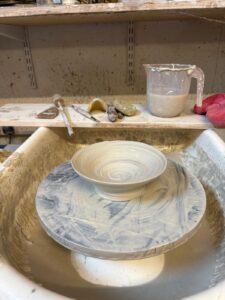
The concept of centring is so integral to Jewish discourse, and indeed to the life of a congregational rabbi, that I was almost dismayed to find the same rules apply here too. Leading a congregation presents the piquant challenge of being centred enough to see and hear everyone, to occupy a middle position from which you can identify the entire spectrum of lives flowing in and out of the synagogue community. Being centred means you are weighted just right to be accessible to, and inclusive of, all. It sounds easy – just as centring a pot sounds easy – until you actually try it.
The patience needed to set up each ‘throwing’ feels Herculean to me. It makes me realise how lacking in patience (savlanut) I am. The Musar movement, created by Rabbi Israel Salanter in the 19th century, describes how best to manage our souls and use the characteristics available to us to be in balance – not too much or too little of anything. My impatience is a deficit of savlanut. I see how much – and how swiftly – I want to see results. I realise that slow, careful entry into the pot making is extraordinarily challenging for me. I want to make it
, not fiddle with preparing the clay before it gets onto the wheel, centring it on the wheel, then carefully honing the worked wedge of clay up and down three or four times to ensure the pot is ready to be built.
Musar has also taught me about being grounded, creating trust (bitachon) for myself and for others so that we trust the process and the order of things (seder). One can’t bypass the stages we need to go through in life, whether it be grief, loss – or even learning to make a pot. Now, the clay and the pot are repeating these lessons back to me. It is difficult precisely because nothing can work without that crucial centring, including in the work of a congregational rabbi, charged with ensuring everything happens carefully, fairly and evenly in community. This week’s portion Acharei Mot-Kedoshim warns against partiality in all settings. I rather like that reminder of steadiness.
I love the lesson that is there every day of my working life – and that it is exactly the same in the pottery studio – an
d maybe that’s because it’s true.
Amy is joining us this Shabbat, as part of our OMER focus on simplicity and beauty. 10.30pm 25th April and then again Erev Shavuot 5-7pm 21st May to make candlesticks and mezzuzot to ground in love, and simplicity. The perfect antidote to the world right now. There are two places left. Please consider joining me, it will be good.
Shabbat Shalom,
Rebecca
Copyright © 2026 Finchley Progressive Synagogue. All rights reserved. Website designed by Addicott Web. | Charity #1167285